


Common challenges include:
- Multiple employees using the same password
- Inability to trace actions to individuals
- Delayed or inconsistent password updates
- Weak or absent MFA enforcement
- No session-level monitoring
If a shared account is compromised:
- Attribution becomes difficult
- Risk propagates across teams
- Compliance audits become problematic
What Is & Team Logic Access?
Team Login Access enables organizations to:
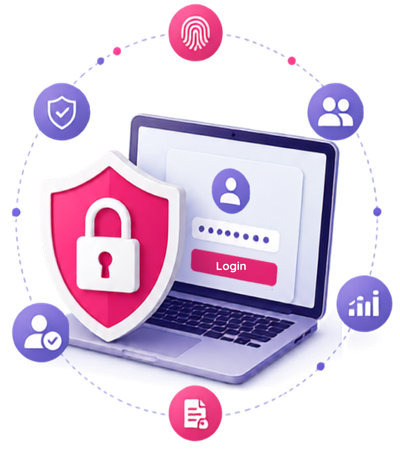
- Protect shared accounts with phishing-resistant MFA
- Tie every login to a verified individual identity
- Enforce role-based authorization
- Monitor session activity in real time
- Maintain centralized, audit-ready logs
Instead of anonymous access, Rainbow Secure enforces:
- Shared account
- Individual authentication
- Visual DNA validation
- Accountable and governed access.
Increase Accountability
Every shared account action is tied to an authenticated individual.
Reduce Insider Risk
Unauthorized or suspicious access attempts are controlled and logged.
Protect Against Credential Exposure
Layered authentication blocks misuse even if shared credentials are exposed.
Simplify Team Collaboration
Teams share access securely without distributing passwords.
Strengthen Compliance
Supports audit requirements across finance, healthcare, and regulated industries.

Blog & Technical Resources
Rainbow Secure provides practical guidance for securing shared credentials, including:
- Securing shared finance email accounts
- Preventing anonymous admin access in IT teams
- Governing marketing and social media team logins
- Managing backup administrator credentials securely
- Audit best practices for shared access
Each guide includes:
- Security architecture insights
- Governance frameworks
- Risk mitigation strategies
- Compliance alignment guidance
-
Can shared accounts still be used securely?
Yes. Each user authenticates individually before accessing the shared account.
-
Can we see who performed specific actions?
Yes. All shared access events are logged with individual attribution and session context.
-
Does this replace traditional password sharing?
Yes. It eliminates insecure password distribution while preserving operational efficiency.
-
Can access be revoked instantly?
Yes. Administrators can terminate sessions and revoke shared access in real time.
Pricing & Editions
Available as:
- Team Access module
- Enterprise IAM feature
- Integrated with MFA, RBAC, Lifecycle & Continuous Trust
Pricing depends on:
- Number of shared accounts
- Number of users

Are You Ready For The Action?
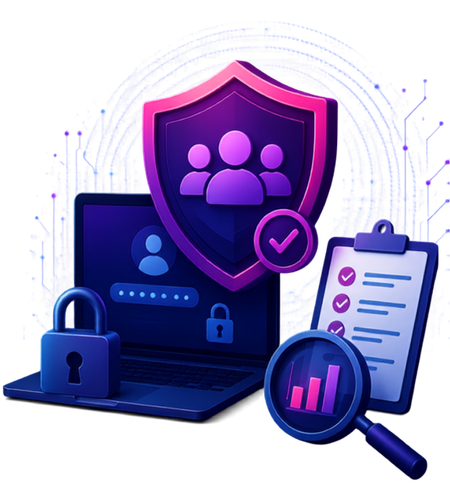
Shared Accounts Should Be Governed — Not Guesswork.
- Shared access is controlled
- Actions are individually attributable
- Sessions are continuously monitored
- Risk is reduced

Your Biggest Security Risk May Already Be Inside Your Company
The most dangerous identity in your organization may not belong to an attacker. It may belong to an administrator.Organizations spend millions detecting external threats.But here’s an…
Read More →
MFA Is Not the Finish Line: Why Identity Security Must Move Beyond the Login
For years, organizations have treated authentication as a security checkpoint:Enter your password → complete MFA → get access.But the threat landscape has changed.Today, attackers don’t necessarily need…
Read More →
The SafePal Breach: When an Order-Tracking Flaw Becomes an Identity Security Crisis
What a crypto hardware-wallet data breach teaches every CISO about authorization, identity, and the danger of “non-critical” dataA cybersecurity incident does not always begin with…
Read More →